
Should You Have a Midwife and a Doula During a Home Birth?

If you're planning your home birth you may be wondering if it's a good idea to have a doula present. Other questions that typically also come to mind revolve around how midwives and doulas differ, as well as how their roles complement each other.
Here's the short version: a midwife and a doula aren't interchangeable.
They do very different things, and when you have both, they work together as a team to support you through one of the most significant experiences of your life.
In this article, we're going to walk you through everything you need to know to make the right decisions for your home birth.
Key Takeaways:
Midwives handle clinical care; doulas handle comfort and support. They're different roles, and you benefit from having both.
Research shows that labor support from a doula and a planned home birth improves outcomes and lowers Cesarean rates.
First-time parents with doulas are often more successful in their home births.
Your midwife is trained to manage complications, so safety is always covered.
For many families, a home birth with both a midwife and doula can still cost less than a hospital birth.
How you build your birth team is entirely your call. We're here to help you figure out what feels right.
How is the role of a midwife vs a doula different in a home birth?
A midwife is your clinical care provider throughout pregnancy, birth, and postpartum. While midwives tend to be deeply attuned to the emotional experience of pregnancy, and while they practice in a holistic way that honors your physical, mental, and spiritual wellbeing, their primary function is clinical. They’re there to monitor your pregnancy, birth, and postpartum and to make sure that you and your baby remain safe and well.
A doula, by contrast, focuses on the physical, emotional, and spiritual dimensions of your experience. Doulas don't have clinical training and don't carry out clinical tasks. Their entire job is support.
Difference Between Midwife and Doula at a Glance
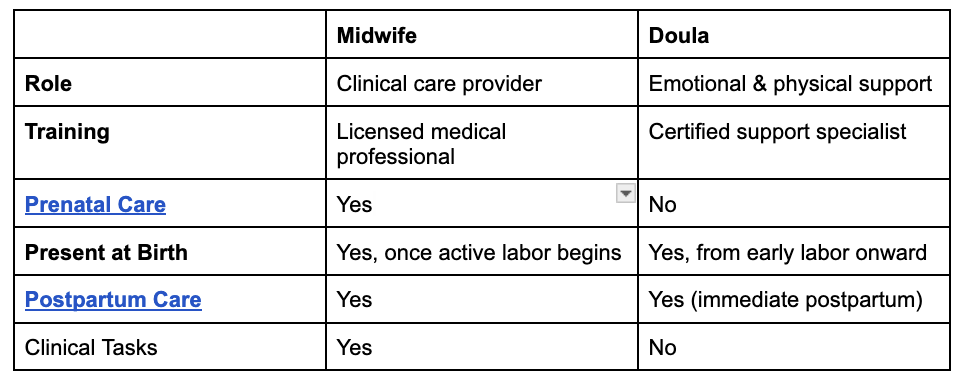
Your doula will often arrive in early labor and stay with you all the way through. Some of what they'll typically offer:
Position changes and movement support
Hydrotherapy and hands-on comfort measures like massage
Guidance and reassurance for your partner or support person
Continuous presence through active labor, transition, pushing, and the immediate postpartum
Your midwife will be continuously present in your home once you're in active labor, typically when you're 6 centimeters dilated or more. They’ll offer emotional and informational support, and will also be handling the full clinical picture, including:
Monitoring fetal heart tones and maternal vitals
Performing vaginal exams and setting IVs
Charting and clinical decision-making if anything deviates from low-risk
Troubleshooting if labor stalls
Assisting with pushing, and catching the baby (unless you or your partner want to do that)
Managing any complications that arise, including a cord around the neck, shoulder dystocia, hemorrhage, or newborn resuscitation if needed
Assessing and suturing any tearing after birth
Completing a full newborn exam
Supporting the beginning of breastfeeding
Monitoring vitals in those early hours for both you and your baby
Related: Is an OB-GYN or a Midwife Right for You?
What's the importance of having both a doula and midwife as part of your home birth support team?
The benefits of having a doula at your home birth go beyond what most people expect. The biggest advantage is that while doulas and midwives are separate roles, we work together really well. We both understand physiologic birth and can support each other in doing our jobs to the best of our ability.
Here's a real example of how this plays out:
Your labor has been going for a long time, and you're exhausted.
Your doula is…
helping your partner support your body in a restful position and offering gentle massage to help you relax.
Your midwife is…
is setting an IV for fluids and making a plan for the next 30 to 60 minutes to help you through the hump. Then re-assessing and making an ongoing, individualized plan.
Everyone is supporting you, clinically and non-clinically, so you can find the strength to keep going and give birth to your baby at home.
We definitely recommend having a doula and a midwife!
First-time birthing parents with doulas are often more successful in their home births. They learn tools for moving through labor sensations, and they have someone whose entire purpose is helping them do just that.
Your midwife needs to step away to chart, track medications, monitor vitals, and stay on top of safety. She can't be right in front of you with every wave, helping you stay grounded. A doula can.
You want your midwife focused on her clinical work so you and your baby are safe. And you'll almost certainly want your doula right beside you while you do the hardest work of your life.
From Our Experience, Having a Doula Makes a Difference
We've never had a client who was disappointed she had a doula. Most say something like, "I can't imagine having a home birth without mine." And almost all of them can't imagine not having a home birth, either. Having both is just setting yourself up with the right home birth support team.
A Word on Cost When Considering Natural Birth Support Options
For most people with private insurance, giving birth at home is still less expensive than giving birth in the hospital, and that's worth sitting with for a moment.
Evidence consistently shows that doulas improve outcomes and lower Cesarean rates. Midwifery care does the same. When you have both, you're also skipping a lot of expenses you might not immediately think about:
Prenatal, birth, and postpartum care are bundled, not billed separately
You're not meeting a hospital deductible at the door
You're less likely to need follow-up care for birth complications, whether that's surgical recovery, pelvic floor therapy, or support after a difficult experience
It really does come down to what you value and how you want to spend your resources. Exploring your natural birth support options early gives you the best chance of building a team that fits both your needs and your budget. If you're considering a home birth in Portland, we're happy to walk you through what the numbers look like for your situation so you can decide what feels right.
What is the role of a doula in childbirth for your loved ones?
It's worth mentioning that a doula isn't just for the birthing parent. They play a big role in supporting partners and family members too.
For partners, especially those who haven't been through a birth before, it can feel overwhelming to not know what to do or how to help. A doula can help them feel confident and give them specific, in-the-moment guidance so they feel genuinely useful.
Doulas can also help normalize things before your midwifery team arrives, like how much bloody show is typical, or why the sounds and sensations of labor can look and sound intense but are completely expected.
For partners who have never seen a birth up close, seeing your partner move through strong contractions, shaking and vocalizing with each wave can feel alarming. A doula can help the people in the room understand that it's normal and that everyone is okay, which takes so much fear out of the experience.
FAQs About Midwives and Doulas
Is a doula necessary for a home birth?
A doula isn't required, but we genuinely recommend having one. Research consistently shows that continuous labor support improves outcomes, and most of our clients say they can't imagine their birth without their doula.
What is the role of a midwife during a home birth?
Your midwife is your clinical care provider throughout pregnancy, birth, and postpartum. She'll be continuously present once you're in active labor, monitoring you and your baby, managing anything that requires clinical care, and staying until you're both stable and well.
What is the role of a doula during a home birth?
A doula's focus is entirely on your comfort, confidence, and emotional experience, from position changes and massage to helping your partner feel calm and useful. They don't perform clinical tasks, but that's the point: their full attention is on you in a way that complements your midwife's clinical focus perfectly.
Can I have a home birth if it's my first pregnancy?
Absolutely, and first-time parents choose home birth with us all the time. As long as your pregnancy is low-risk, you're a great candidate, and we'll walk you through everything you need to know to feel confident and prepared.
What happens if something goes wrong during a home birth?
Your midwife is trained to identify and manage complications as they arise, from stalled labor to postpartum hemorrhage, and we carry the equipment and medications to handle a wide range of situations. If a transfer to the hospital is ever needed, we'll be with you every step of the way and will have already established a relationship with a backup provider so that transition is as smooth as possible.
Will my insurance cover a midwife or doula?
Midwifery care is covered by many private insurance plans, and we're happy to help you figure out what your benefits look like. Doula care isn't typically covered, though some HSAs cover doulas. We can point you toward options that may help make it more accessible.
How do I find a doula in Portland?
We work closely with a number of wonderful doulas in the Portland area and love helping our clients find the right fit for their family. Reach out to us and we'll be happy to share some recommendations.
Build Your Home Birth Support Team

Choosing the right midwife and doula makes sure you have exactly the right support where you need it most during such an important time in your life.
Having both a doula and a midwife present during your home birth, means each can focus entirely on their role. With a doula supporting you emotionally and physically, your midwife can perform her responsibilities of caring for the safety of you and your baby.
If you're exploring home birth in Portland and want to talk through your options, we'd love to hear from you. We're here for a conversation about what you're hoping for and how we might be able to help.
Works Referenced
American College of Obstetricians and Gynecologists. (2019). Safe prevention of the primary cesarean delivery. Obstetrics & Gynecology, 133(2), e164–e173. https://pubmed.ncbi.nlm.nih.gov/30575638/
Bohren MA, Hofmeyr GJ, Sakala C, Fukuzawa RK, Cuthbert A. Continuous support for women during childbirth. Cochrane Database Syst Rev. 2017;7(7):CD003766.
https://pubmed.ncbi.nlm.nih.gov/28681500/
Nguyen, B., et al. (2023). The effect of doulas on maternal and birth outcomes: A scoping review. PMC. Cureus. 2023;15(5):e39451. https://pmc.ncbi.nlm.nih.gov/articles/PMC10292163/
Sandall, J., Soltani, H., Gates, S., Shennan, A., & Devane, D. (2016). Midwife-led continuity models versus other models of care for childbearing women. Cochrane Database of Systematic Reviews, 4(4), CD004667. https://pubmed.ncbi.nlm.nih.gov/27121907/
Stapleton, S.R., Osborne, C., & Illuzzi, J. (2013). Outcomes of care in birth centers: Demonstration of a durable model. Journal of Midwifery & Women's Health, 58(1), 3–14. https://pubmed.ncbi.nlm.nih.gov/23363029/
World Health Organization. (2020). Year of the Nurse and the Midwife. https://www.who.int/campaigns/annual-theme/year-of-the-nurse-and-the-midwife-2020